Investigating Swimming Effect of Holograms in Mixed Reality
Aug 1, 2024· ,,·
1 min read
,,·
1 min read
Subin Raj
Harshitha Belagavi Rajaprakash
Amaresh Chakrabarti
Pradipta Biswas
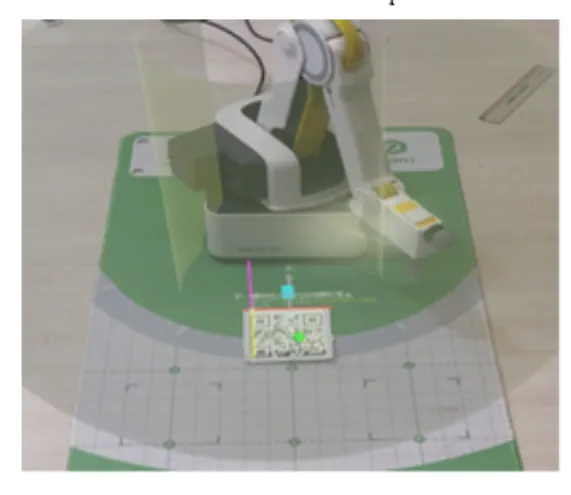 Image credit:
Abstract
Extended Reality (XR) technologies have recently presented a novel approach for human-robot interaction. In these advancements, humans manipulate holograms to define the robot’s path. However, ensuring the stability of these holograms is crucial, as their position appears altered from the user’s perspective when viewed through a Head-Mounted Display (HMD). This swimming effect of the hologram directly impacts robot path planning. This paper proposed a new way for analysis of swimming effect of the hologram using robot, and compared three existing methods with spatial anchors, employing the world locking tool (WLT), and a method without spatial anchors or WLT. An experiment was conducted, and the results revealed that the WLT approach significantly reduces the swimming effect of the hologram compared to the other two methods when the user views from different viewpoint.
Type
Publication
International Conference on Pattern Recognition(ICPR), 2024
Click the Cite button above to demo the feature to enable visitors to import publication metadata into their reference management software.
Create your slides in Markdown - click the Slides button to check out the example.
Add the publication’s full text or supplementary notes here. You can use rich formatting such as including code, math, and images.